



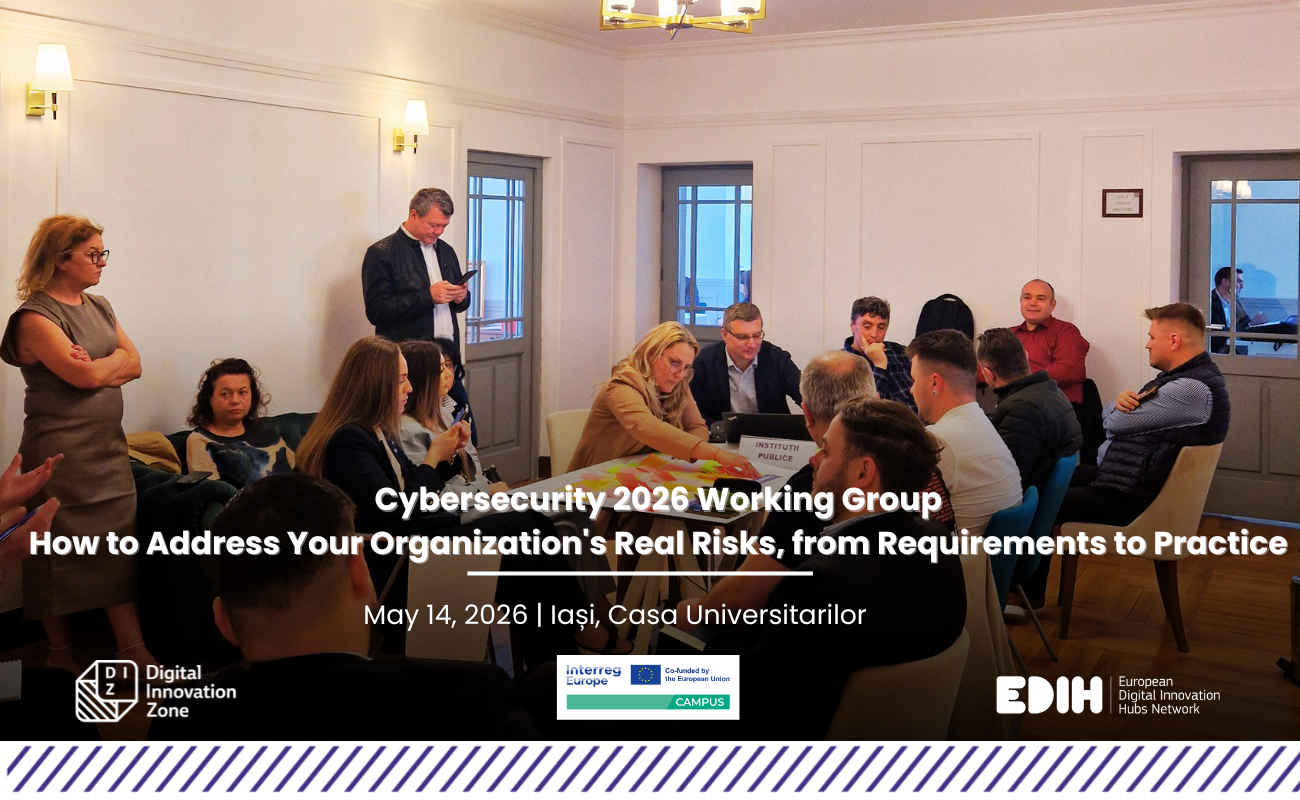
On Thursday, May 14, 2026, Casa Universitarilor in Iași became the strategic hub for regional cybersecurity. Under the umbrella of the eDIH-DIZ 2.0 program and the CAMPUS | Interreg Europe Project, the event “Cybersecurity 2026 Working Group. How to Address Your Organization’s Real Risks, from Requirements to Practice” successfully shifted the focus from the general question of “what should we do?” to pragmatic actions and immediately applicable defense plans for organizations and public institutions.
In an increasingly volatile digital landscape, the message of the day was clear: cybersecurity is not a product, but a continuous process of secure digitalization.
Figures and the Community Behind the Event
The working group brought together over 50 participants from a broad spectrum of critical sectors:
- Public Sector: Representatives of Local Public Authorities (UATs) and educational institutions.
- Healthcare: IT managers and officers from hospitals—a vital sector targeted by new regulations.
- Business Environment: SMEs eager to protect their intellectual property and customer data.
- Experts: Tech solution providers, academic representatives, and regulatory authorities.
Focus on Solutions: Workshops and Cyber Starter Packs
The highlight of the event consisted of 4 sector-specific roundtables. Unlike a traditional conference, participants worked side-by-side with experts to build “Cyber Starter Packs”– sets of concrete measures tailored to the specific needs of each domain:
- Public Institutions: Aligning with NIS2 directive requirements and protecting citizens’ data.
- Healthcare: Securing medical equipment and patient medical histories.
- Education: Protecting digital educational infrastructure.
- SMEs: Business continuity in the event of a cyberattack and safeguarding digital assets.
Critical Questions, Direct Answers
The interactive sessions tackled the hottest topics of the moment:
- Incident Response: What steps do we take in the first few minutes following a cyber incident?
- Compliance: How do we transform the requirements of the NIS2 directive from a legal obligation into a competitive advantage?
- Resources: How to access the services and audits offered through the eDIH-DIZ 2.0 program to support organizations without massive security budgets.
The Power of the Ecosystem: Partnerships for the Future
The success of this working group is rooted in close collaboration among the public, academic, and private sectors. We extend our gratitude to the partners who made this dialogue possible:
- Strategic Partners: The CAMPUS Project (Interreg Europe), the North-East Regional Development Agency, and national authorities (the National Cyber Security Directorate – DNSC, and the National Cybersecurity Coordination Centre – NCC-RO).
- Academic Partners: “Gheorghe Asachi” Technical University of Iași (TUIASI), “Grigore T. Popa” University of Medicine and Pharmacy Iași (UMF Iași), and “Alexandru Ioan Cuza” University of Iași (UAIC Iași).
- Tech Partners: Quartz Matrix, Expertware, Acronis, and Orange Business.
We thank all participants, speakers, and partners for helping us deliver an interactive format specifically designed for SMEs, hospitals, and public institutions.
Are you ready to take the next step in securing your organization?
The DIZ team is ready to support you through the support services available within the eDIH-DIZ 2.0 program.
In the meantime, we invite you to review the Support Services Call for the Digital Transformation of Public Institutions in the North-East Region here: Open Calls – Digital Innovation Zone.
For more information about the call and how to apply, you can contact Adina Ghinea, Public Institutions Digitalization Expert, at: proiecte@digital-innovation.zone
We also invite cybersecurity experts to join the Regional Advisory Cybersecurity Working Group. You can register via the registration link available here.
Conclusion of the Day
We left Casa Universitarilor not just with information, but with actionable plans. Cybersecurity is not a barrier to innovation; it is the very foundation upon which we build a secure, digitalized, and resilient region.