


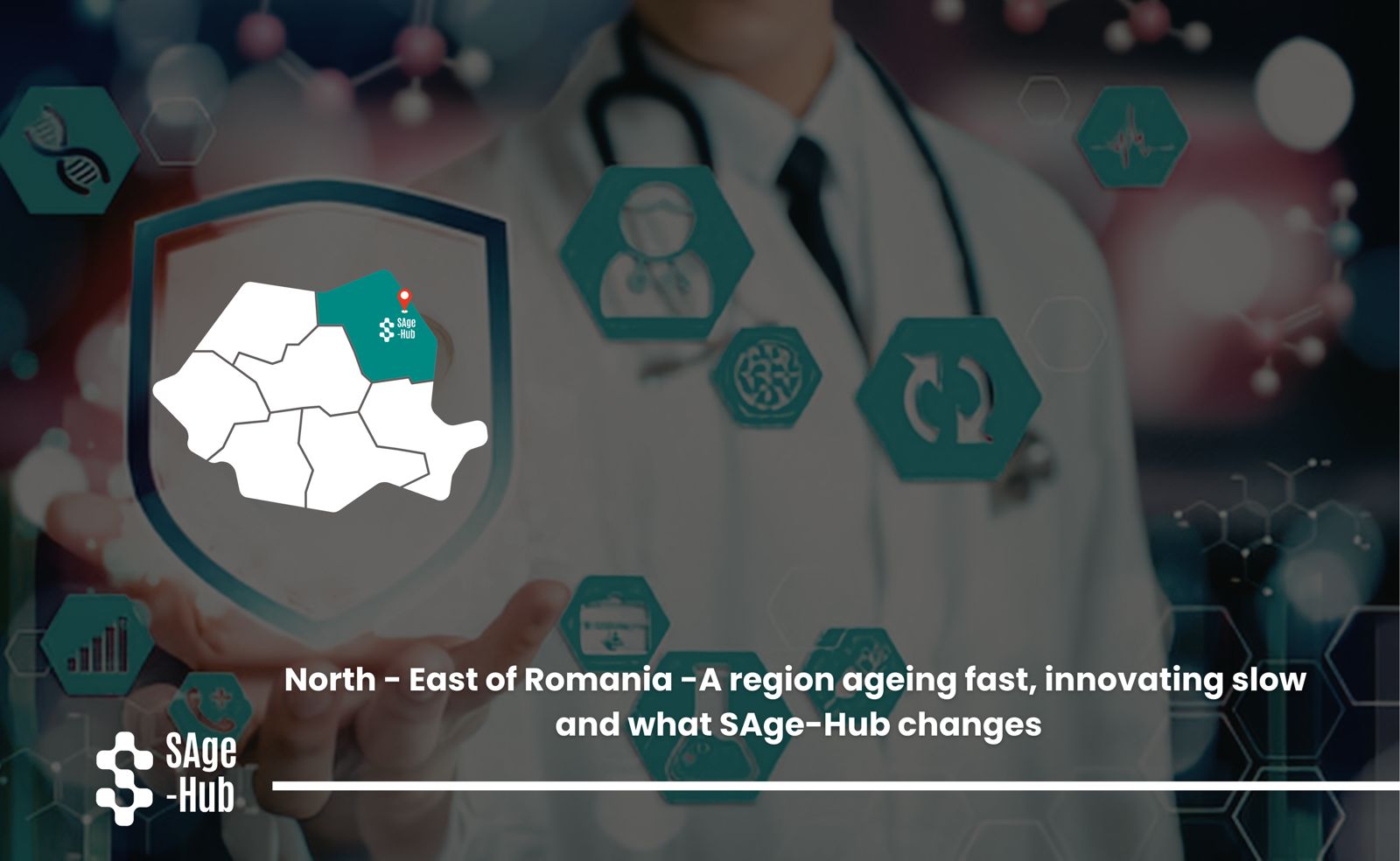
Nord-Est Romania’s healthtech SMEs are building solutions for a rapidly ageing population but have no infrastructure to validate and scale them. A new EU programme changes the equation.
Drive through any of the villages that dot the hills of Bacău, Botoșani, or Vaslui and the demographic reality of Nord-Est Romania is impossible to miss: the elderly outnumber the young, GPs are scarce or absent, and the nearest hospital is hours away. This is not a science fiction scenario, it is the present. As of January 2025, people aged 65 and over represent 20.3% of Romania’s population, surpassing the under 14 cohort by nearly 927,000 people, while the demographic aging index has climbed to 131 elderly per 100 young people and continues to rise. In Nord-Est, Romania’s most populous but least economically developed region, where rural communities dominate the landscape, these figures are felt with particular intensity.
Meanwhile, across the region’s cities, small companies and university spinoffs are developing digital solutions for exactly these challenges: remote monitoring devices, AI-assisted diagnostics, telehealth platforms, and smart aging applications. The talent is there. The ideas are credible. What is missing is the bridge between a working prototype and a solution that real users have tested, that investors trust, and that European markets can absorb.
The infrastructure gap that stalls innovation
For a healthtech SME anywhere in Nord-Est, the innovation lifecycle runs into structural walls at every stage. There is no regional procurement mechanism that allows hospitals to act as first customers for local startups. Health data, the raw material for AI-driven solutions, remains fragmented, poorly interoperable, and inaccessible to innovators: Romania has not yet adopted a national health data governance strategy, though one is in preparation. And while the Digital Innovation Zone (DIZ), as the region’s European Digital Innovation Hub, actively supports SMEs across all six counties of Nord-Est (from Iași to Bacău, Suceava, Botoșani, Neamț, and Vaslui) the absence of a demand-side instrument means that even well-supported startups have no pathway to clinical validation within their own health system.
The consequence is predictable: capable local SMEs must seek real-world validation abroad, while the elderly population of rural Nord-Est continues to be served by a healthcare system that absorbs 44% of its expenditure on hospital beds rather than preventive, community-based, or technology-assisted care. Romania currently holds no recognised European Innovation Partnership on Active and Healthy Ageing (EIP on AHA) Reference Site (the EU’s principal benchmark for regional excellence in this field), a gap that reflects both the scale of the challenge and the urgency of addressing it.
What the EU now requires of Romania
The EU is not merely requesting that Romania adapt, it is making adaptation a condition of continued access to structural funds, recovery financing, and the emerging European single market for digital health.
The European Health Data Space (EHDS, Regulation EU 2025/327), in force since March 2025, will require Romania to designate Health Data Access Bodies, build interoperable health record systems, and connect to cross-border data infrastructure by 2029. The National Health Strategy 2023 – 2030 commits the country to shifting from hospital-based to community and digital care models. The National Strategy on Long-Term Care and Active Ageing 2023 – 2030 requires expanded, technology-supported services for elderly people living independently. The NRRP has allocated €442 million for an integrated eHealth and telemedicine system, with disbursement conditions creating real implementation pressure. And the Nord-Est Smart Specialisation Strategy identifies health and eHealth as priority domains, conditioning access to ERDF structural funds for 2021 – 2027.
For Nord-Est SMEs, this alignment of obligations creates both urgency and opportunity. The solutions they develop today, if properly validated and aligned with EU standards, will be positioned at the front of a rapidly expanding European market for age tech currently valued at $4.2 trillion globally and growing at 7.6% annually.
SAge-Hub: what it is and why it matters for Nord-Est SMEs
SAge-Hub – Smart Ageing Synergies: Strengthening Interregional Innovation through Living Labs and Digital Hubs – is a programme funded by the European Union through the i3 Capacity Building component, bringing together six European regions: Romania, Greece, Portugal, Catalonia, Finland, and the Canary Islands. In Nord-Est, it is coordinated by the Digital Innovation Zone (DIZ), the region’s EDIH, with an active presence across all six counties, in close collaboration with the North-East Regional Development Agency, ensuring that the programme’s reach extends to SMEs throughout the entire region, not just its urban centre.
What makes SAge-Hub structurally different from previous regional programmes is its demand-driven architecture. Rather than asking SMEs to develop solutions and then find users, it establishes a network of Digital Living Labs where real users – elderly people across the consortium’s six countries – co-create, test, and validate solutions from the start. For a Nord-Est startup that currently has no pathway to clinical or real-world validation at home, access to living labs in Finland, Portugal, or Catalonia is not a networking benefit, it is a market-entry instrument.
Through SAge-Hub, enrolled SMEs receive:
- access to specialised workshops built around Nord-Est’s regional development needs and S3 priorities;
- entry into an international network of experts spanning technology, healthcare, business, and research;
- the opportunity to test their solution in Living Labs with real users across all six consortium countries;
- a direct pitch to an international group of investors actively targeting age and health tech; listing on the European marketplace for age/health tech solutions;
- a Digital and Innovation Readiness Assessment connecting them to interregional value chains and future funding channels
All at no financial cost to the company, through EU funding.
SAge-Hub does not ask Nord-Est SMEs to leave their region to compete in Europe. It brings the European infrastructure – the users, the experts, the investors, the regulatory alignment, directly to them, building on DIZ’s existing regional network across all six counties. Companies from Bacău or Suceava have the same access to the programme as those based in Iași. In a region where the demand for smart aging solutions is distributed across an entire territory, this breadth of reach is not incidental, it is what makes SAge-Hub genuinely fit for purpose.
The convergence of demographic pressure, EU compliance obligations, and an emerging but fragile local innovation ecosystem makes Nord-Est one of the most compelling contexts in Eastern Europe for smart aging investment. SAge-Hub is the instrument that converts that potential into a structured, funded, internationally connected pathway for the SMEs that build the solutions, and for the elderly population that needs them.