



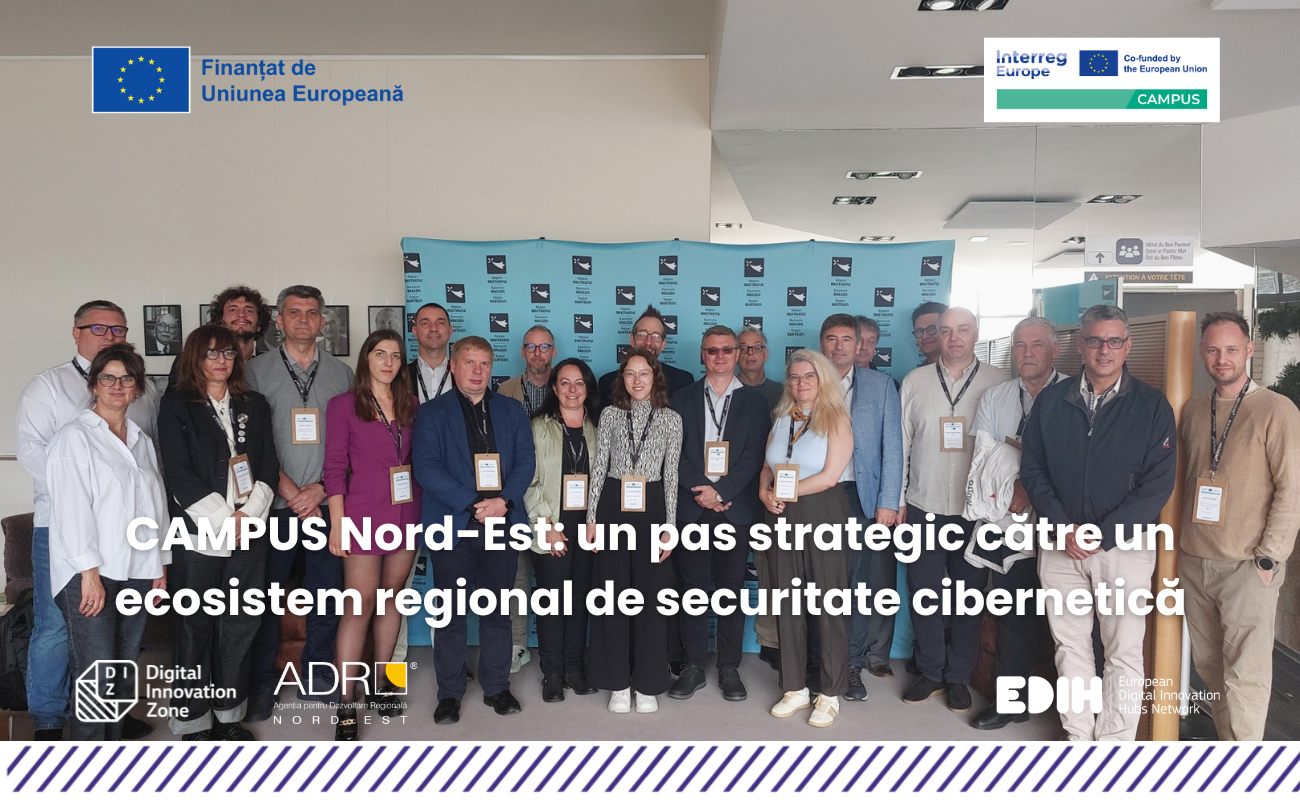
On 21 November 2025, at the Gheorghe Asachi Technical University of Iași, as part of #DIZisIT day, Digital Innovation Zone hosted the meeting of the Regional Advisory Working Group for Cybersecurity – CAMPUS. The event brought together representatives from the public sector, private sector, and academia around a shared objective: shaping a coherent regional initiative to strengthen digital resilience in Romania’s North-East Region.
From European lessons to regional action
Discussions built on the models and lessons learned during the study visit to Rennes (Brittany, France), where participants explored a mature ecosystem: the Bretagne Cyber Campus. It is recognized nationally and across Europe for:
- clear regional governance,
- stable collaboration between public authorities, private companies, and academia,
- multi-level funding (local, regional, national, and European),
- a “one-stop-shop” model that reduces fragmentation in the cybersecurity space.
A key takeaway from the Rennes model was that value does not come from a centralized physical infrastructure, but from a functional collaboration network supported by institutional mechanisms and trust.
Why CAMPUS is needed in the North-East Region
Participants quickly reached a consensus: a CAMPUS-type initiative is not only timely, but necessary in the North-East Region. It can significantly contribute to:
- strengthening the digital resilience of public institutions and critical infrastructure;
- supporting companies in developing and testing cybersecurity solutions;
- building and retaining cybersecurity skills at regional level.
It was emphasized that CAMPUS North-East must be a collaboration hub, not an infrastructure project. In this context, it was proposed that Digital Innovation Zone, as a European Digital Innovation Hub and IT Observatory under RIS3 North-East, should act as the driving force bringing together the public–private–academic ecosystem.
Critical challenges requiring coordinated solutions
A central point of the discussions was the major imbalance between private sector engagement and public sector involvement. Although vulnerabilities are evident, participation from public institutions remains limited, creating bottlenecks even in implementing free or EU-funded solutions.
Examples from hospitals and local public authorities highlighted:
- severe shortages of IT/cyber personnel;
- IT roles assumed informally, without clear accountability;
- lack of digitalization strategies;
- absence of risk analyses required for compliance with NIS2, DORA, and other regulations.
The conclusion was clear: a realistic, phased approach is needed, starting with pilot projects in institutions with a minimum capacity to absorb change.
Development directions for CAMPUS North-East
Strategic directions discussed included:
- developing skills through academic–industry collaboration, aligning university and doctoral programs with real industry needs;
- exploring a shared services model across all levels—from training & awareness to consulting, research, and cybersecurity solutions/products;
- building a mixed funding logic based on the North-East Regional Programme, EU calls, and private or in-kind contributions.
An essential element identified was the need for a “single regional voice” capable of formulating relevant positions and projects in dialogue with national and European stakeholders (DNSC, RO-NCC, etc.).
Next steps: from discussion to implementation
The meeting concluded with a clear set of agreed actions, including:
- conducting a regional mapping of needs, resources, and stakeholders in cybersecurity;
- clarifying the governance framework for CAMPUS North-East;
- drafting a strategy outline (objectives, pillars, services, timeline);
- launching a local pilot project as a proof of concept;
- developing a non-technical awareness package for public decision-makers;
- shaping scenarios for shared services;
- consolidating a common regional position to attract funding.
The CAMPUS Working Group meeting confirmed both an urgent need for coordination in cybersecurity in the North-East Region and the willingness of private and academic actors to contribute actively. The critical success factor remains public sector engagement, supported by clear mechanisms, pilot projects, and tangible evidence of impact.
CAMPUS North-East is not just a concept—it is a strategic opportunity to build digital resilience, skills, and trust at regional and even cross-border level.
Why CAMPUS North-East can work: a European-validated model
CAMPUS North-East does not start from scratch. It draws direct inspiration from a mature and functional regional model: CyberCampus Bretagne (France), considered a European best-practice example.
In Brittany, CyberCampus operates as a distributed regional ecosystem—not as a single building—and brings together:
- over 160 cybersecurity companies;
- approximately 8,000 jobs in the regional cyber sector;
- over 3,500 students annually in dedicated training programmes;
- strong collaboration between public administration, academia, and industry, supported by multiannual public funding and a strategic vision endorsed at regional and national level.
The success of this model demonstrates that digital resilience is built through collaboration networks, shared services, and clear governance—not through isolated initiatives.
Parallels with the North-East Region: real potential, urgent need
The North-East Region faces a different context, but has clear foundations for adapting this model:
- a relevant regional IT market, with Iași as the main hub;
- Digital Innovation Zone (DIZ / eDIH-DIZ) as a multi-partner platform and “one-stop-shop” for SMEs and public authorities;
- ADR North-East as a key policy and funding actor;
- substantial allocations under the North-East Regional Programme 2021–2027 for digitalization and innovation.
At the same time, the data discussed within the working group indicate systemic vulnerability—especially in the public sector and in critical domains such as healthcare—where the lack of skills, capacity, and structured approaches remains acute. This contrast makes CAMPUS North-East not only an opportunity, but a necessity.
Get involved in building CAMPUS North-East
CAMPUS North-East is open to collaboration and co-creation. The next phase will move from strategic dialogue to concrete actions, pilot projects, and shared regional cybersecurity services.
We invite the following to join this effort:
- public institutions (local authorities, hospitals, public agencies) seeking to strengthen digital resilience and prepare for NIS2 requirements;
- private companies in IT & cybersecurity or critical sectors, interested in testing, piloting, and developing shared solutions;
- universities and research centers that can contribute to training, applied research, and technology transfer;
- support organizations and clusters willing to promote a coordinated regional approach.
👉 If you would like to contribute to mapping regional needs, defining CAMPUS services, or developing a pilot project, we invite you to contact us and become part of the core team building CAMPUS North-East. Sign up here!